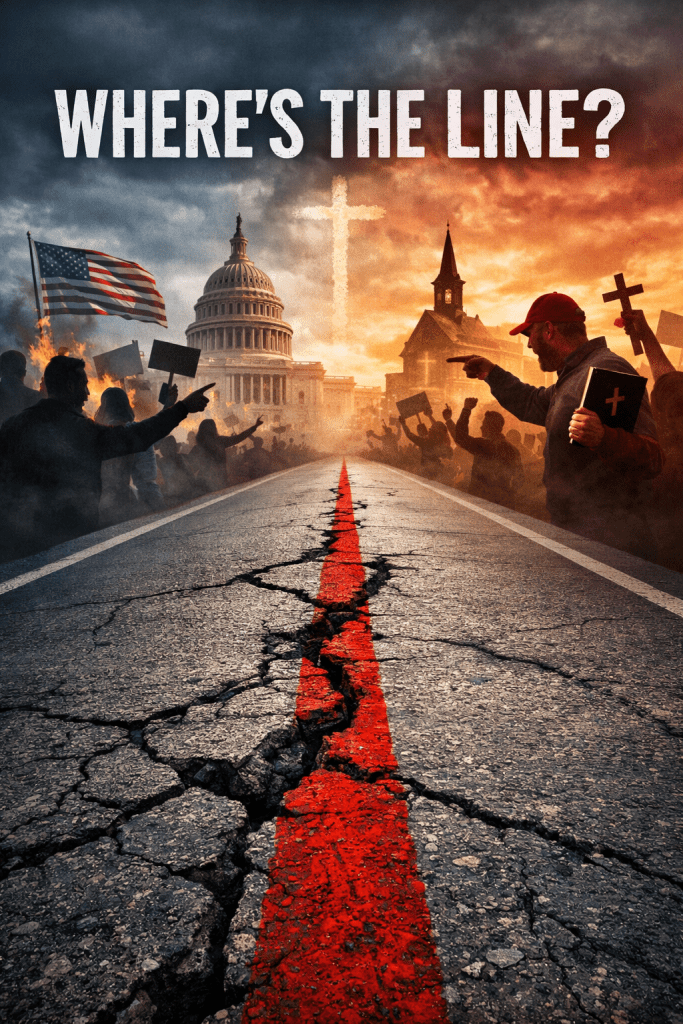
I keep asking a question that feels unavoidably Christian and painfully unanswered:
Where’s the line?
At what point do followers of Jesus finally say, “Enough”?
Enough cruelty masquerading as strength.
Enough corruption excused as strategy.
Enough moral rot baptized as faithfulness.
I ask this as a Christian shaped by the United Methodist tradition, a tradition that insists grace never excuses harm, that personal holiness is inseparable from social holiness, and that faith is always measured by fruit. I ask this as someone who loves the church enough to tell the truth about what is killing it.
The extreme margins of both liberal and conservative political and religious movements reveal a disturbing reality: when ideology becomes ultimate, morality becomes optional. Moral compromise exists on both sides of the aisle. Power deforms whoever worships it. Pride is bipartisan. Hypocrisy knows no party.
But that truth does not justify the embrace, much less the celebration, of a political regime and cultural posture that openly mocks, belittles, dehumanizes, and contradicts the way of Jesus.
And that is precisely what so many self-professed Christians have chosen to do.
Jesus said we would be known by our fruits (Matthew 7:16). So let’s be honest about the harvest.
We see the heinously horrific treatment of immigrant neighbors, people Scripture commands us to welcome, protect, and love (Leviticus 19:34; Matthew 25:35).
We see the brutal execution of citizens while Christians shrug or cheer, despite a Savior who refused the violence of empire even at the cost of his own life (Matthew 26:52).
We see grotesque concentrations of wealth and power, entangled with names long associated with exploitation and abuse (Epstein, in case you’re wondering), while Jesus’ warnings about the rich are quietly ignored (Luke 12:15; Luke 16:19–31).
We hear constant name-calling, cruelty, sexism, racism, and public mockery, while the One Christians claim to follow blesses the meek, condemns dehumanization, and identifies himself with “the least of these” (Matthew 5:3–12; Matthew 25:40).
And still…nothing.
Where is the moral outrage from those who once insisted character matters?
Where is the repentance from those who taught me that sin corrodes the soul?
Where is the prophetic courage to say, “This is not the Gospel. This is not who we are. This is not the way of Jesus”?
Instead, we watch politicians debate and dismiss the theology of the Pope, as though Christianity now belongs to the powerful rather than to the poor, the wounded, and the forgotten. As if faith itself is only valid when it serves political dominance.
What we are witnessing is a breathtaking act of theological dishonesty.
Jesus never addressed the modern culture-war talking points that led to the overwhelming evangelical support of one party. But he spoke constantly about love of neighbor, care for the vulnerable, rejection of violence, humility, truthfulness, mercy, and justice. He warned explicitly against religious leaders who obsessed over being “right” while neglecting “the weightier matters of the law: justice, mercy, and faithfulness” (Matthew 23:23).
Are these so-called issues really worth the erosion of democracy?
Worth normalizing cruelty as virtue?
Worth sacrificing the church’s credibility and moral witness for generations to come?
The prophet Amos didn’t mince words:
“I hate, I despise your festivals… But let justice roll down like waters, and righteousness like an ever-flowing stream” (Amos 5:21–24).
Jesus echoed that same judgment when he condemned religious performance divorced from love (Matthew 23), and Paul reinforced it when he reminded the church that without love, even the most confident faith is empty noise (1 Corinthians 13).
So I ask again, where is the line?
When will my evangelical brothers and sisters find the faith-filled courage to say, “Enough! We’ve lost our way”?
I fear that many are deeply entangled, so captive to pride, fear, ego, greed, and power that they can no longer recognize the fruits of the Spirit when they appear: love, joy, peace, patience, kindness, generosity, faithfulness, gentleness, and self-control (Galatians 5:22–23). Instead, we see their opposites defended with Scripture ripped from context and grace weaponized to silence critique.
And yet, against my own cynicism, I cling to hope.
I still believe no one is beyond transformation. Grace still disrupts. Repentance is still possible. Resurrection still follows crucifixion.
John Wesley believed God’s grace is always reaching for us…before we know it, while we resist it, and long after we think it’s too late.
But grace does not mean silence.
Hope does not mean denial.
Love does not mean moral surrender.
So I will commit myself, again and again, to the way of Jesus.
To love over fear.
To truth over power.
To humility over dominance.
To justice over comfort.
I will measure my faith not by political victories, but by fruit. I will refuse to confuse cruelty with courage or power with faithfulness. And I will keep embodying, however imperfectly, the fruits of the Spirit in a world addicted to their opposites.
And maybe one day if enough Christians choose the way of Jesus over the way of empire, I won’t feel the need to say, “I’m not that kind of Christian.”
Until then, I’ll keep asking the question the church seems desperate to avoid.
Where’s the line?
 Tuesdays with Morris