On this Maundy Thursday, I find myself reading, re-reading, and meditating upon the Gospel reading from the Lectionary (John 13:1-17, 31-35).
Two extremely important things happen in this text…
1. Jesus demonstrates the importance of humble service when he takes on the role of a servant and washes the disciples feet. After washing the disciples feet, he instructs them to do the same. Now, most would read into the text that Jesus isn’t simply calling his followers to wash each others feet, but is calling on his followers to humbly serve.
2. Jesus gives a new commandment: Love one another! “I give you a new commandment, that you love one another. Just as I have loved you, you also should love one another. By this everyone will know that you are my disciples, if you have love for one another.” (John 13:34-35)
In the cultural context of Indiana, in the midst of the great debacle known as RFRA, the Gospel reading could not be more appropriate.
No matter one’s views on issues of sexuality, marriage equality, etc…we are called to serve and to love.
Jesus did not practice discrimination. He was known as a “friend of sinners”. The religious folks didn’t like him because he associated with “notorious sinners”. He broke down barriers and showed grace, mercy, love, and compassion to “the least of these”. If he was hard on anyone, it wasn’t the “known sinners”…it was the pious religious types!
It seems like Jesus, the same guy who for his first miracle turned water into wine…not just a little bit of wine either, would not refuse to serve or love anyone. Jesus would bake a cake for anyone. Jesus would bake a pizza for anyone. Jesus would provide a flower arrangement for anyone. Jesus would love and serve anyone.
As followers of Jesus, our call is the same…to love and serve anyone.
So, on this Maundy Thursday, I’m thankful for the example of Jesus. I’m thankful for his obvious demonstration of humble service. I’m thankful and challenged by his call to love one another.
Easter is just around the corner! For those of us in ministry, it means we are in the midst of a busy season. The preparation and Holy Week itself, while extremely powerful, can be very draining on ministry leaders and their families.
This is also one of those times of year when we start seeing a slight increase in worship attendance. Christmas Eve and Easter brings out folks who maybe only make it to church once or twice a year.
In Christian circles, these irregular church attenders are often referred to as “Chreasters”. Let’s be honest, that’s a pretty derogatory term. It probably reveals that we don’t really appreciate having the Chreasters join us on Christmas Eve and Easter.
Continuing in the spirit of honesty, we don’t appreciate Chreasters because Chreasters impose on our normal ways of doing things. For example:
They park in our parking sports (meaning we might have to park farther away)
They sit in our pews/chairs (meaning we might have to sit on the other side of the sanctuary)
They dress too informal (meaning they don’t take things seriously enough)
They dress to formal (meaning they take things too seriously)
They don’t understand how we do things (meaning they don’t respect our traditions)
They don’t know the difference between the Bible and the hymnal
They don’t have the Lord’s Prayer memorized
They sit when we’re supposed to stand
They stand when we’re suppose to sit
They made the sign of the cross
They don’t make the sign of the cross
They don’t sing our songs
They are only here to make grandma happy
They are only here to get right with Jesus so the Easter Bunny/Santa will give them what they want
They will only be here this week and then it will be back to “normal”
Well, it’s nice to have a full church today, but it will be depressing next week
And, the list could go on and on. We’ve all seen it. We’ve all heard the comments. We’ve seen the exchange of dirty looks when someone does something on the above list. We know the apprehension good church folk have when it comes to Chreasters (or “new” folks in general). Heck, plenty of ministry leaders have pretty poor attitudes when it comes to Chreasters too!
But me, I love the Chreasters!
We live in a day and age where fewer and fewer people have even a remote desire to be involved with anything religious. We live in a day when the “build it and they will come” projects are no longer as effective as they may have been 20-50 years ago. We live in a day where our “Christian” nation is becoming a larger and larger mission field. We live in a day where pastors and laity alike have to become missionary in mindset and action.
So, I love the Chreasters! However, I’m sad because they are actually diminishing in number.
At least with the Chreasters we have one or two shots each year to share the hope, life, joy, grace, mercy, peace, and love of Jesus on our own turf. That’s one or two more chances than we generally get with the unchurched and dechurched populations in our communities. Therefore, we should really make the most of it!
We should celebrate the fact that there are folks out there who still believe it’s important to go to church…even if it is only once or twice a year.
We should celebrate that they broke their normal Sunday morning routine to share part of their day with us!
We should go beyond radical hospitality when it comes to our Chreasters!
We should realize that this is a huge opportunity…because maybe, just maybe this year something will click and they will see the value in the community and worship life of the church!
Maybe we church folk should spend the next couple of weeks praying for the Chreasters…praying for our churches…praying that we won’t be jerks when the Chreasters do something on the list above…praying that all who join our churches in worship (on any given Sunday) will feel welcome, wanted, and experience God in a powerful way.
There are times when I think the church should resemble a used car.
Too often in the church, we worry about little things as if the church is a new car.
You know how it is with a new car…We don’t let the kids eat or drink in a new car because we don’t want to get a stain on the seats. We try to avoid driving through puddles because we don’t want to get the car dirty. We park far away at the supermarket because we don’t want our doors dinged by other shoppers. We don’t allow certain items or people in the new car because we want to keep that new car smell as long as we can. And the list goes on and on…
But, as soon as dad spills a little coffee, we begin to relax. Next thing you know, the kids are downing Happy Meals, Capri Sun’s, and M&M’s in the backseat. Of course, we strive to do our best to keep the car clean and presentable. However, we’re not as uptight about little spills and some dirty floor mats. The car is a tool that is meant to be used.
Now, when we buy a used car, we still like to keep it neat and clean. However, we tend not to worry as much because someone else had already stained the seats and floor mats and had a couple of door dings at the supermarket. We realize more quickly that the car is a tool meant to be used.
The temptation in the church is to treat it like a new car, whether it’s brand spanking new or has been around for 100+ years. We worry about stains on the carpet. We worry about candle wax on the pews or chairs. We get nervous if the pastor, praise band, choir, or parents of young children bring drinks or snacks into the sanctuary. “What if they spill something?”
But, the church building is a tool intended to be used. The church building, like a car, will get a bit messy if it is being used by the church family. Now, just because the building shows signs of use does not mean it’s dirty. We should work hard to make sure it’s clean, presentable, and that the bathroom’s don’t smell like dirty diapers. But, stains on the carpet, marks on the walls, and other indications of use mean that the church is being used. And, shouldn’t that be the goal?
Sometimes we get upset when others bring their coffee into the sanctuary. We say things like, “Don’t they know that bringing coffee into the sanctuary is disrespectful?” Here’s the deal, I hope our churches are reaching people who don’t know how to “play church.” I hope our churches are reaching folks who are not well versed in church etiquette.
I’ve always been “that guy” in churches I’ve served. When I walk into the church, you can pretty much guarantee there will be a cup of coffee in my hand. We talk about the church being “the family of God”. I don’t know about your family, but when I get together with my family, we don’t have too many rules about where we drink our coffee (of course, my mother’s family was from Kentucky, so…).
I have a friend who, on the first Sunday in the new sanctuary of his church, took a cup of coffee and poured it out on the new carpet. He said, “This building is meant to be used. It’s meant to get dirty. We shouldn’t be so focused on our building that we fail to show hospitality to our guests.”
A vital congregation will show signs of being used. There will be stains on the carpet. There will be evidence of candle wax on the pews. There will be scuff marks on the paint. And we should celebrate that! It doesn’t mean the church is dirty. It means that we aren’t so uptight that we don’t let people get comfortable and be themselves. We allow kids to be kids. We allow parents to be parents. We allow people to be people!
I don’t know about you, but I believe the folks who spill coffee, drip candle wax, and scuff up the paint are more important than the carpet, the pews, and the walls.
In some ways, it’s about hospitality. If we have too many rules, we run the risk of making people focus more on whether or not they are doing things wrong that they might not connect with God and others. When folks come to church, they should be able to slow down and relax. They shouldn’t have to worry too much about whether or not they are breaking long-standing rules that really don’t have anything to do with connecting with Jesus.
Maybe churches should just stock up on Scotch Guard and stain remover!
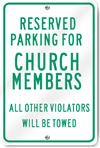
The other day, I received a catalog that included the following sign:
It also included the following sign:
Is this really the message we want to send to our members, visitors, and community? Does this indicate that the church is a tool to be used for connecting people with Christ and the community? Does this indicate that all are welcome or that we are a “members only” club? Does this indicate that we want you to make yourselves at home?
Just some things I’m thinking about on a Friday afternoon!
Yesterday, I was reading some devotional material and came across a bit on hospitality that is simple, yet important.
“Christian hospitality differs from social entertaining. Entertaining focuses on the host: the home must be spotless; the food must be well prepared and abundant; the host must appear relaxed and good-natured. Hospitality, by contrast, focuses on the guests. Their needs – whether for a place to stay, nourishing food, a listening ear, or acceptance – are the primary concern. Hospitality can happen in a messy home. It can happen around a dinner table where the main dish is canned soup. It can even happen while the host and the guest are doing chores together. Don’t hesitate to offer hospitality because you are too tired, too busy, or not wealthy enough to entertain.” (Life Application Study Bible Devotion, Day 264)
As I was thinking about this short reflection, I was reminded of how our practice of hospitality in the church can sometimes be selfish.
Here’s what I mean by that: In the church, our practice of hospitality tends to be on our terms. Hospitality is practiced in a manner that fits our wants, our needs, our desires. Hospitality in the church, at times, is more focused on what makes us feel good rather than what might make our guests feel safe, comfortable, and accepted. Hospitality is practiced in a manner where we offer what we believe people want/need rather than actually identifying what people desire.
If hospitality is in our terms, then it really isn’t hospitality.
When selfish hospitality is called out, we tend to get defensive. We have a hard time believing that what we value, appreciate, and enjoy might actually make our guests uncomfortable. In our defensiveness, we blame our guests. We ask things like, “Well, how could you not feel welcomed and a part of things when we do ______? Something must be wrong with them if they don’t enjoy _______”
Selfish hospitality believes that our guests should become just like us. They should learn to like what we like. They should learn to behave like we behave. Instead of admitting that some of our practices might actually be inhospitable, we indicate that the real problem is not with us, but with the guest.
If we are truly going to practice hospitality, we need to be willing to put others needs ahead of our own. If something is clearly offensive or creates a roadblock for our guests, we should probably rethink the practice. We need to be willing to accept people as they are. We need to be willing to learn from our guests. We need to take the focus off ourselves and place it on our guests. Their needs should trump our needs.
How have you practice selfish hospitality? Are there practices you need to let go of in order to be more considerate to the needs of your guests?
“Contribute to the needs of God’s people, and welcome strangers into your home.” ~ Romans 12:13
Late Wednesday afternoon, I had the joyous opportunity to stop into one of my favorite places in the world, The Heorot Pub and Draught House in Muncie, IN. There’s something beautiful about the Heorot. Every time I visit, I’m overcome with an overwhelming sense of peace, joy, rest and comfort. In all honest, there is some kind of spiritual connection for me at the Heorot, as my soul feels at ease as soon as I walk through the doors.
This afternoon, I found myself listening to Jim White vs. The Packway Handle Band’s song “Jim 3:16”. My favorite lyrics say: “Half my life I lived in fear I’d burn in hell, but now it’s clear, that a bar is just a church that serves beer.”
Put these experiences together, and it’s easy to understand why the line “a bar is just a church that serves beer” keeps running through my head. As I think about the line, I found myself thinking, “I wish more churches were like bars.” Let’s be honest, some bars tend to be a little bit more fun, welcoming, hospitable, friendly, and full of life than some churches.
Wednesday at the Heorot, as soon as I sat down, the bartender acknowledged me, finished dealing with another customer, and quickly made his way over. The bartender was friendly and knowledgeable. He was able to give in-depth descriptions of various offerings and give helpful suggestions. After placing my order, he kind of gave an affirming acknowledgement of my selection and quickly had a tasty pint of People’s Notorious BIP in front of me (I think I was missing my Lafayette friends just a bit)! He also made small talk and continually checked on me to make sure I was having a pleasant experience. He made me feel welcomed, but did not overwhelm me as if he was desperate for my business. Later, we realized some of our mutual connections to the Muncie music scene of the 90’s and did some reminiscing!
After my experience with a friendly and knowledgeable bartender, I found myself wondering who are the bartenders at church? Who are the people who are friendly, knowledgeable, and making sure guests have a pleasant experience? Are our bartenders welcoming, but not pushy and overwhelming? I can think of a few churches I’ve visited where the hospitality staff have obviously read some books, developed a system, and by golly, they are going to work that system. And, it goes one of two ways…it is cold and impersonal or it is a bit too much. Of course, there is the way of being totally ignored, which I’ve also experienced at a number of churches. Okay, maybe I’m being too hard on the church. There are a few who get it right! Back to the bar…If I asked my bartender a question about any number of the ridiculous number of beers at the Heorot, he would have been able to give me a wealth of information. Not only that, with a few simple questions, he could point me in the direction of something new and different that might be of interest. Again, who are the bartenders at church?
In between conversations with the bartender, another patron quickly struck up a conversation. It was a very interesting conversation. It started with an invitation to play chess (which he had learned to play at the Heorot). We then talked about music and the beautiful city of Muncie. As we continued our conversation, he opened up about his multiple trips to prison and some time he had spent at the state hospital in Richmond. He talked about his family in Kentucky, his various jobs, prison food, and gambling in Vegas. He talked about how he’d been through some rough phases, but things seemed to be going well now.
After my experience talking with my fellow patron, I found myself wondering if the church is creating safe places where people can be open, honest, and vulnerable? This guy opened up almost immediately. Granted, the beverages being served may have helped loosen the atmosphere. But, I wonder if those of us in the church (especially those of us in leadership positions) are more focused on keeping up appearances than being real? How many times, when we ask “how are you doing” do we get the routine answers of “great”, “fine”, “pretty good”, “I’m blessed”, and so on? Do we have environments in the church where people can have a sense of safety, trust, and love that they can be fully honest? Do we have places in the church where it is okay to not be okay?
While I was talking and enjoying my beverage, an older gentleman began playing the piano. He played some boogie-woogie, honky tonk, walkin’ bass swingy goodness. Seriously, he was jamming! He even threw in a couple of familiar hymns! Nothing like hearing a nice Charles Wesley melody while sitting in your favorite pub! But, it wasn’t a performance. It was fun and carefree, yet beautiful! It helped usher in a sense of pure joy!
So, while listening to the gentleman play the piano, I found myself wondering if the church is too focused on performance and perfection? This guy wasn’t performing. He wasn’t perfect. But, it was enjoyable, moving, fun, and excellent (remember, excellent doesn’t always mean perfect)! I wonder if there are folks who would be willing to share their talents if we weren’t so focused on “the show” of church/worship?
It was also spontaneous. I wonder if there is any room for spontaneity in the church? I mean, I suppose we’re all up for the movement of the Holy Spirit, as long as it fits within our regularly scheduled services!
This evening, I find myself wondering what the church can learn from the bar. While we in the church may view the bar as part of our mission field, we just might have something to learn from the bar.

 Tuesdays with Morris